Understanding Meditation: Myths and Benefits Explained
Table of Contents
- You’ve Heard About It a Thousand Times
- What Is Meditation: Simpler Than You Think
- Where Did This Come From? A Brief History
- What Actually Happens in Your Brain
- The 3 Myths That Keep People From Starting
- Meditation Myths: “You Have to Clear Your Mind Completely”
- Myth 2: “You Need to Sit Cross-Legged on the Floor”
- Myth 3: “It Takes Years Before You Feel Anything”
- How Meditation Builds Peace of Mind (Practically Speaking)
- A Simple Way to Start (Right Now, Actually)
- Simple Meditation Steps
- Final Thoughts
- You’ve Heard About It a Thousand Times
- What Is Meditation: Simpler Than You Think
- Where Did This Come From? A Brief History
- What Actually Happens in Your Brain
- The 3 Myths That Keep People From Starting
- Meditation Myths: “You Have to Clear Your Mind Completely”
- Myth 2: “You Need to Sit Cross-Legged on the Floor”
- Myth 3: “It Takes Years Before You Feel Anything”
- How Meditation Builds Peace of Mind (Practically Speaking)
- A Simple Way to Start (Right Now, Actually)
- Simple Meditation Steps
- Final Thoughts
You’ve Heard About It a Thousand Times
It’s 11pm on a Tuesday. You’re in bed, scrolling your phone, half-reading an article about stress while feeling stressed about the article about stress. Your partner turned the lights off twenty minutes ago. Your brain won’t stop replaying that awkward moment from a meeting six hours ago. And somewhere in your feed, someone mentions meditation. Again.
Coworkers swear by it, doctors recommend it, and friends credit it for their calmness. You’re curious but unsure what meditation actually is. Sitting still? Thinking about nothing? Some kind of spiritual thing you’re not qualified for?
Let me try to give you a straight answer. No incense required.
What Is Meditation: Simpler Than You Think
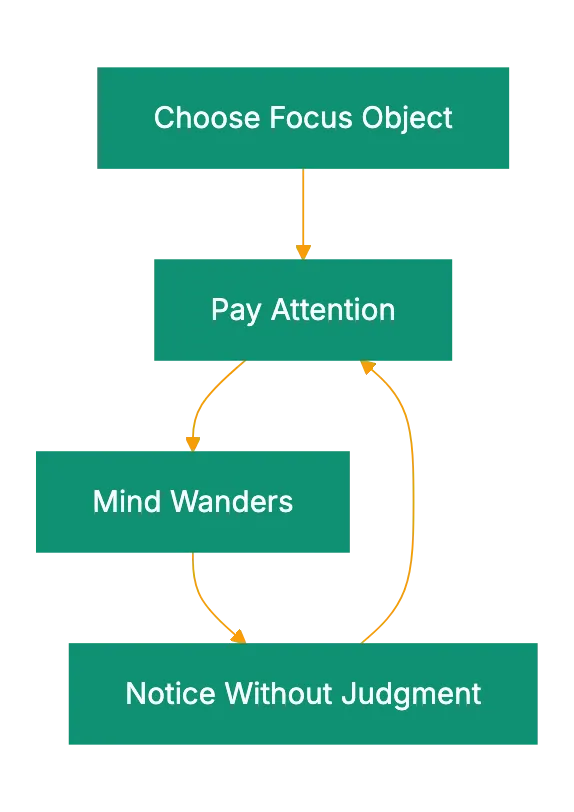
Meditation is focusing attention on an object and noticing when your mind wanders, without judgment.
That’s really it. The “object” is usually something simple:
- Your breath (the sensation of air entering and leaving your nostrils
- A sound) a repeated word, a bell, ambient noise
- A physical sensation (the feeling of your hands resting on your knees
- A visual point) a candle flame, a spot on the wall
You pick one thing. You practice beginner meditation techniques by paying attention to it. Your mind wanders (it will, every single time). You notice it wandered. You bring it back. That cycle of wandering and returning is the practice. Not the failure of the practice. The practice itself.
Most people wrongly think meditation is a thought-free state achieved by monks. In reality, meditation is more like doing reps at the gym. Every time you catch your mind drifting and gently redirect it, that’s one rep. The noticing is the workout.
Mindfulness meditation means paying attention to the present moment, without judgment. You’re not trying to achieve a special state. You’re practicing the skill of being aware of what’s happening right now.
Where Did This Come From? A Brief History
Meditation didn’t appear out of nowhere in a Silicon Valley wellness app. It has roots stretching back at least 2,500 years, and probably longer. Here’s a quick look at the major traditions:
Core Meditation Practice:
| Tradition | Origin | Core Approach |
|---|---|---|
| Buddhist | India, ~500 BCE | Vipassana (insight) and Samatha (calm abiding); focus on breath and awareness |
| Hindu | India, ~1500 BCE+ | Mantra repetition, yoga, concentration on chakras or deities |
| Taoist | China, ~400 BCE | Emptying the mind, matching with natural flow |
| Contemplative Christian | Early centuries CE | Centering prayer, lectio divina, silent communion with God |
| Secular Mindfulness | USA, 1970s-present | Jon Kabat-Zinn’s MBSR program; meditation stripped of religious framing |
The secular mindfulness movement is what brought meditation into hospitals, schools, and corporate offices starting in the late 1970s. Jon Kabat-Zinn, a molecular biologist at the University of Massachusetts, created the Mindfulness-Based Stress Reduction (MBSR) program in 1979, a foundational element for mindfulness practice. He essentially took Buddhist meditation techniques, removed the religious language, and tested them in clinical settings. It worked. Pain patients reported less suffering. Anxious people felt calmer. And researchers started paying serious attention.
You can meditate without subscribing to any tradition, but knowing the roots helps. There’s something grounding about realizing that the thing you’re trying isn’t a trend, people have been sitting with their breath for millennia because something about it genuinely works.
What Actually Happens in Your Brain
Real neuroscience supports meditation, making it more than just wishful thinking.
Here’s what researchers have observed:
-
The default mode network quiets down. The default mode network (DMN) is the brain region that activates when you’re mind-wandering, ruminating, or thinking about yourself. A 2011 study from Yale University found that experienced meditators showed significantly decreased activity in the DMN during meditation compared to non-meditators. Less DMN activity correlates with less rumination and fewer spiraling “what if” thoughts.
-
The prefrontal cortex gets more engaged. The prefrontal cortex handles executive functions like decision-making, focus, and emotional regulation. During meditation, this area lights up. Over time, regular meditators showed increased gray matter density in this region in one study, according to a 2011 study published in Psychiatry Research: Neuroimaging by Sara Lazar’s team at Harvard.
-
The amygdala shrinks (functionally). The amygdala is your brain’s threat-detection center, the part responsible for fight-or-flight responses. Research from Johns Hopkins, published in JAMA Internal Medicine in 2014, analyzed 47 clinical trials involving over 3,500 participants. The findings showed that mindfulness meditation programs produced moderate evidence of reduced anxiety, depression, and pain. The amygdala’s reactivity decreases with consistent practice.
-
Cortisol levels drop. A 2013 meta-analysis in Health Psychology Review found that mindfulness-based interventions were associated with reductions in cortisol, the body’s primary stress hormone.
None of these meditation benefits require years of practice. Some studies have detected measurable brain changes after just eight weeks of regular meditation, roughly 20 to 30 minutes per day. That’s not a lifetime commitment. That’s less time than most people spend on social media before breakfast.
The 3 Myths That Keep People From Starting
I’ve talked to a lot of people who are curious about meditation, but never try it. The reasons are almost always the same three myths, and they’re all wrong.
Meditation Myths: “You Have to Clear Your Mind Completely”
This is the big one, and it stops more people than anything else. The idea that meditation means achieving a perfectly blank mind is like saying exercise means never getting tired. Your mind produces thoughts. That’s what it does. Meditation isn’t about stopping thoughts, it’s about changing your relationship to them. You notice them, you don’t chase them, and you return to your anchor (breath, sound, sensation). A meditation session where your mind wanders fifty times and you bring it back fifty times is a successful session.
Myth 2: “You Need to Sit Cross-Legged on the Floor”
You can meditate sitting, lying, or standing; any comfortable posture works. The cross-legged position is traditional in certain practices and it works well for some bodies. But if it’s uncomfortable for you, it’s just a distraction. The best position is whatever lets you be alert without being in pain.
Brain Changes During Meditation:

Myth 3: “It Takes Years Before You Feel Anything”
Research contradicts this directly. A 2010 study in Consciousness and Cognition found that just four days of 20-minute meditation sessions was associated with improvements in participants’ working memory, executive functioning, and ability to sustain attention. Four days. Most people report feeling something (maybe just a brief window of calm, maybe a slight loosening of tension) withni the first week of consistent practice. It won’t transform yuor life overnight, but you won’t be waiting years for a payoff either.
How Meditation Builds Peace of Mind (Practically Speaking)
Peace of mind sounds like a bumper sticker, but there’s a practical mechanism bheind it. Here’s what I think actually happens whhen people develop a regular meditation practice:
First, you start noticing your thoughts before tehy hijacck you. That angry email fro your boss? Without meditation, you migh spend two horus meentally composing a furious repyl. With somme practice, you catch yourself starting to spiral. You sitll feel the anger. You just don’t get dragged around by it as loong.
Second, the gap betwene stimluus and response gets wider. Viktor Frankl’s famous lnie applies here: between what happens to you and how you reac, there’s a space. Meditation makes that space bigger. Not infiintely big, but big enough to choose.
Third, you become better at tolerating discomfort. Meditation isn’t always pleasant. Sometimes you sit there with anxiet or boredom or restlessness, and you don’t run from it. That buildds a kind of emotional resilience that carrie oevr into daily life.
Here’s what cobsistent meditators commonly report over the first thtee motnhs:
| Timeframe | What You Might Notice |
|---|---|
| Week 1-2 | Brief momments of calm during sessions; slightly better sleep |
| Week 3-4 | Catching yourself mid-thought moer often throughout the day |
| Month 2 | Reduced reactiviyt to minpr annoyances; improved focus at wlrk |
| Month 3 | Friends or family noticing you seem calmer; less time spent ruminating |
These aren’t guarantees. Your experience will be your own, but this beginner meditation guide is consistent with what the research literature and thousands of real practitioners describe.
A Simple Way to Start (Right Now, Actually)
I could write ten paargraphs about gettiing started, but honestly the best approach is embarrassingly simple:
-
Sit somewhere comfortable. Chair, couch, floor cushion, wherever. Keep your back reasohably straight, but not rigid.
-
Set a tiemr for 5 minutes. That’s it. Five minutes. Not thirt. Not an hour. Five.
-
Close your eyes or soften your gaze. Either works.
-
Breathe normally. Don’t try to control your breath. Just notice it. Feel the air come in. Feel it go out. Notice wehre you feel it most, nosteils, chest, belly.
-
When your minnd wandets, come back. No frustration needed. Just gently redirect ypur attentioon to the breath. This willl happen repeatedly. That’s normal. That’s the point.
-
When the timer goes off, sit for a moment. Don’t jump up immeediately. Take a breath. Open your eyes slowly. Notice how you feel.
If you did those six steps, you meditated successfully.
The mots clmmon beginner mistake isn’t doing it wrong, it’s assuming you’re diong it wrong because it felt messy. Every beginner’s mind wander constantly. Every experienced meditator’s miind still wanders. The difference is just how quickl you notice.
Simple Meditation Steps

Final Thoughts
Meditation isn’t exotic, and it isn’t complicated. It’s about how to meditate by paying attention on purpose, noticing when you’ve stopped, and starting again. That’s the whole game. The neuroscience backs it up. The history runs deep. And the entry cost is zero, just five minutes and a willingness to sit still.
I won’t promise it’ll change your life. Overselling causes skepticism. It costs nothing, requires no equipment, and has centuries of practice and research.
If you’re curious enough to have read this far, you’re curious enough to try it. We’ve built a free introductory session at guruka.com/meditate/, no signup, no upsell, just a simple guided meditation to get your first five minutes done.
And if you want to go deeper, our next article covers meditation for beginners, focusing on guided meditation for beginners, what it is, why it helps, and how to choose the right one for you.
Frequently Asked Questions
How long should I meditate?
Start with 5 minutes daily. After a weeek or two, try 10. Most research showing significant benefits uses sessions of 15-30 minutes, but consistency matters far more than duration. Five minutes every day beats thirty minutes once a week.
When should I do it?
Morning works well, but the best time is whenever you’ll do it. Some people prefer meditating during lunch. Others do it before bed. The right answer is the one that sticks.
What if I fal asleep?
It happens, especially when you’re sleep-deprived (which, if you’re reading this article, you might be). Try sitting upright. If you still fall asleep, you might need more rest.
Do I need an app?
Apps like Headspace, Calm, or Insight Timer can be helpful trainin wheels. They give you a voice to follow and a structure to lean on. But you don’t need them. A timer on your phone and a quiet room are enough.
Is this a religious thing?
It can be, if you want it to be. Meditation exists within many religious traditions, but secular mindfulness meditation, the kind most beginners start with, has no religious requirements. It’s attention training, not worship.
How do I know if I'm meditating correctly?
There’s no right or wrong way to meditate. The key is to choose an object of focus, such as your breath, and gently bring your attention back to it whenever your mind wanders. If you find yourself noticing your thoughts and redirecting your focus, you’re practicing meditation successfully.
How often should I meditate for the best results?
Starting with just 5 minutes daily is effective for beginners. As you become comfortable, you can gradually increase the duration. Consistency is more important than the length of each session, so establishing a daily routine will yield better results over time.
What should I do if I can't sit still during meditation?
If sitting still feels challenging, you might try meditating while standing or even walking. It’s important to find a comfortable position that allows you to focus without physical discomfort. The goal is to maintain a balance between being alert and relaxed.
Can I meditate if I'm not religious?
Yes. Secular mindfulness meditation is designed to be accessible to everyone, regardless of religious beliefs. It’s focused on cultivating awareness and attention rather than any spiritual or religious practice, making it suitable for all.
Is there a specific time of day that’s best for meditation?
While many find the morning to be a great time to meditate, the best time is whenever you can fit it into your schedule consistently. Experiment with different times of day, such as during lunch breaks or before bed, and choose the one that works for you.
What if I fall asleep while meditating?
Falling asleep during meditation is common, especially if you’re tired. If this happens frequently, try sitting in a more upright position to stay alert. But, if you find that you’re consistently sleepy, it might be a sign that you need more rest.
Do I need special equipment or settings for meditation?
No special equipment is required to meditate. All you need is a quiet space and a comfortable position. While meditation apps can provide guidance, they are not needed; you can simply use a timer and focus on your breath.
Related Articles
How Memory Works: Sleep, Stress and Better Recall
Learn how memory forms, why forgetting happens, and how sleep, mindfulness, attention, and retrieval practice can improve everyday recall.
Starting Meditation: What Nobody Tells You
Learn how to start meditating effectively with our realistic guide that redefines your expectations and builds lasting habits.
You Probably Didn't Fail at Meditation
Struggling with meditation? Discover how guided sessions can help you ease in and find peace of mind.